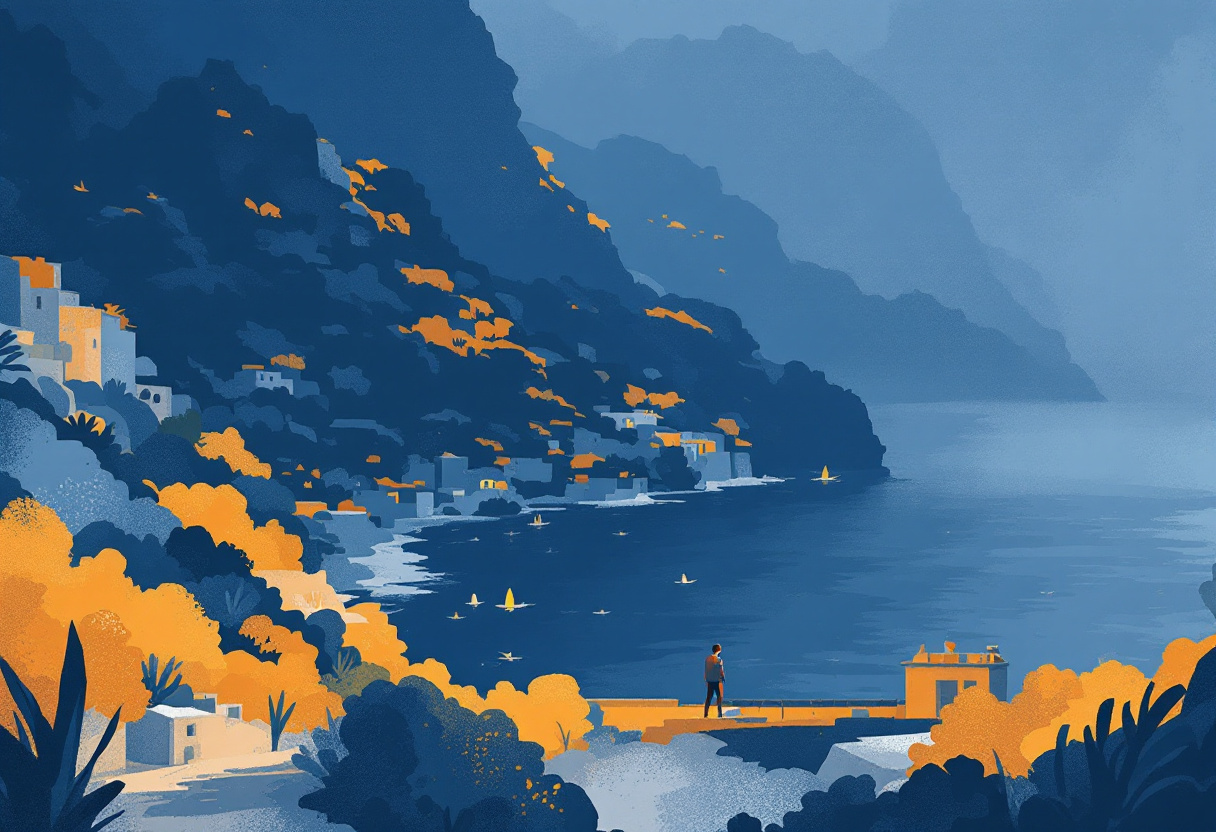
Amalfi Coast travel guide: the logistics nobody warns you about
Part of the Greece travel guide: the honest first-timer's handbook (2025) guide
The Amalfi Coast is one of the most beautiful places in Europe and one of the most logistically stressful. Here's how to go in June, base in Praiano, and take ferries.
The SS163 — the road that runs along the Amalfi Coast — is 40km long and in places wide enough for one and a half cars. It has no barriers on the seaward side. It passes through eleven tunnels blasted through cliff faces. It carries tour buses, delivery trucks, private cars, scooters, tourist minibuses, and the SITA local bus in both directions simultaneously. In July and August, the journey from Positano to Amalfi town takes somewhere between 45 minutes and two hours depending on the traffic, and there is no way to know in advance which it will be.
Most Amalfi Coast travel guides spend three paragraphs on the scenery (accurate, extraordinary) and one sentence on the roads ("the drive can be challenging"). This guide is going to do the opposite, because the logistics are what determine whether your Amalfi experience is what you came for.
In the context of an Italy summer trip, the Amalfi Coast is the high-demand destination that requires the most advance booking and the most careful planning — the booking sequence for high-demand destinations applies here more than almost anywhere else in Europe.
Don't drive the Amalfi Coast. Take the ferry.
This is the single most important logistical decision you will make about this trip.
The ferry service connecting Positano, Praiano, Amalfi, Ravello (via Amalfi), and Salerno runs from roughly April to October and is operated by several companies including Travelmar and NLG. The journey from Positano to Amalfi by ferry takes 35 minutes and costs €8–€12. The same journey by road in peak season takes 45 minutes to two hours.
The reasons most people drive: they rented a car at Naples airport before they understood what the road was actually like. The reasons to take the ferry: it's faster, it shows you the coastline from the angle it's meant to be seen, and it eliminates the specific anxiety of the SS163 entirely.
If you must drive: go early morning or late evening when traffic is minimal. Never in the afternoon in peak season. Park at the top of any town rather than attempting the descent to the harbour — the parking garages on the hillsides are expensive (€20–€30 a day) but the alternative is circling a road with no room to circle.
The SITA bus is the local option and runs frequently (roughly every 40 minutes in peak season). It's cheap (€1.80–€2.50 per journey), uses the same road as the cars, takes longer than the ferry. It's fine for short single-direction journeys; ferry is better for the main coast movement.
Where to base yourself
Praiano over Positano. Ravello for quiet and views. Amalfi town for transport convenience.
Positano is the postcard village — the stacked houses in terracotta and white climbing the cliff above a small beach. It's beautiful and it costs significantly more than anywhere else on the coast. A mid-range hotel in Positano in July runs €250–€400 a night. The beach is small and pebbly and crowded. It's not a bad place to spend a day; it's an expensive place to base yourself for four nights when Praiano is 20% cheaper and a 15-minute ferry ride away.
Praiano is meaningfully quieter than Positano and meaningfully cheaper. Accommodation from €120–€200 a night for good mid-range options. The village is steep but compact; most of the restaurants and the beach are accessible from the ferry landing without dramatic climbing.
Ravello is 7km inland from Amalfi town on a road that winds up the hillside. The Villa Rufolo gardens (€7 entry) have a famous terrace with a view over the coast that Richard Wagner described as inspiring Parsifal. The Villa Cimbrone gardens (€8 entry) have the Terrace of Infinity, a cliff-edge balustrade with a view that justifies every superlative directed at it. Ravello has genuinely good restaurants, fewer tour groups than the coastal towns, and accommodation priced for a slightly less crowded market.
Salerno is at the eastern end of the Amalfi Coast, has a ferry connection to all the main coast towns, and has accommodation at roughly 40–50% of Positano prices. A good mid-range hotel in Salerno's historic centre costs €80–€120 a night. For people doing a longer stay of 4+ nights, Salerno as a base with daily ferry trips is both cheaper and less logistically stressful than staying in Positano.
When to go
June and September are clearly better than July and August. Early June and late September are better still.
In July, the SS163 road closures due to accidents or breakdowns are not unusual. Accommodation in Positano in August books out 4–6 months in advance. The ferry queues at Positano harbour in August are long enough that boats occasionally depart before everyone is aboard.
June offers warm weather (24–27°C), swimmable sea temperatures (21–23°C), manageable crowds, and accommodation available with 6–8 weeks' notice rather than 6 months. Late September is similar — the summer heat has eased, the sea is still warm (24–25°C), and the visitor numbers drop noticeably after the first week.
The price difference between early June and August on the same hotel can be 40–60%.
The ferry timetable — a note that will save your afternoon
The Amalfi Coast ferry service does not run all day. The last afternoon ferry is earlier than you expect.
The last ferry from Amalfi to Positano in June typically departs around 6:15pm. If you've not checked the return ferry time, you discover it at the ticket office when the person behind the counter tells you the last boat left 20 minutes ago. The SITA bus still runs, but you've now added an hour on the SS163 to your afternoon.
The fix: check the current timetable at coopsantandrea.it or the Travelmar site on the day of travel. Ask your accommodation for the current schedule when you arrive.
Day trips worth doing
Capri: the island is 50 minutes from Positano by hydrofoil (€20–€25 one way). The Blue Grotto (€15 per person) is genuinely spectacular if you time the visit for mid-morning when the light angle is right. The town of Anacapri in the upper part of the island is less crowded than Capri town and has better restaurant options.
Pompeii: staying on the Amalfi Coast and visiting Pompeii requires a full day and a base at Salerno to manage the transit. From Salerno, the Circumvesuviana train to Pompeii Scavi takes about 30 minutes and costs €3. The site itself (€16 entry) requires 3–4 hours. Start at opening (9am) because the crowds build significantly through the morning.
Paestum: 40km south of Salerno, largely overlooked by Amalfi Coast itineraries. Three extraordinarily preserved Doric temples from the 6th and 5th centuries BC, in better condition than most things in Rome. Accessible from Salerno by 45-minute bus or train. Admission €10. One of the more underrated sites in Italy.
The honest truth about the Amalfi Coast
The Amalfi Coast is one of the most beautiful places in Europe. It's also one of the most logistically stressful summer destinations in Italy, and the gap between the experience on a good plan and the experience on a bad one is wider than most places.
Three decisions determine which version you get: when you go (June beats July significantly), where you base yourself (Praiano or Ravello over Positano; Salerno for budget), and how you move (ferry over car on the SS163, always).
This is exactly the kind of research rabbit hole that Budge was built for — you can ask it follow-up questions about any of this and it remembers what you care about across the whole conversation.
Do those three things and the coast delivers on its promise: towns draped on cliffs above turquoise water, lemon groves on terraced hillsides, the light in the late afternoon turning everything amber. The coast is worth going to. It requires being intelligent about it.
Plan your trip
Plan your own trip with AI
Budge turns a conversation into a full travel plan — flights, hotels, budget, and everything in between.
Start planning for free →