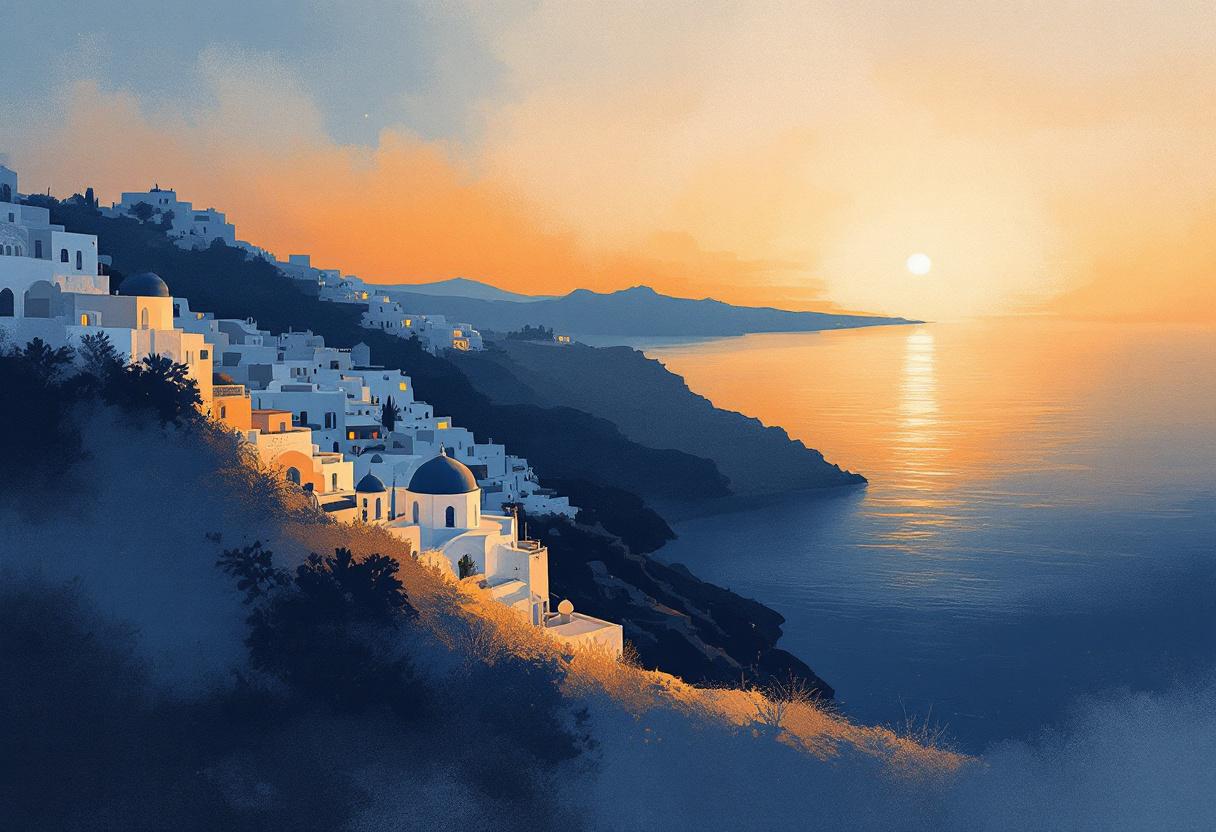
Santorini and Mykonos: are they worth it, or is everyone just lying?
Part of the Greece travel guide: the honest first-timer's handbook (2025) guide
An honest verdict on Santorini and Mykonos — who they're genuinely right for, who should skip them, and what the Instagram photos aren't showing you.
The photograph you have seen of Santorini was taken at 6am. The blue dome, the white wall, the caldera dropping away behind it into blue water — that photograph was taken by someone who set an alarm, walked to the right spot before dawn, and waited. There were perhaps four other people there. By 9am, the same spot had thirty people angling for the same shot. By noon it was a queue.
This is the central fact about both Santorini and Mykonos: they are extraordinary in the right conditions and genuinely disappointing in the wrong ones, and the right conditions require deliberate planning rather than showing up in peak season and hoping.
So — are they worth it? Yes to Santorini, qualified yes to Mykonos. But the qualification matters enough to spend a post on it. The broader Greece context and its alternatives covers the full picture of what Greece offers beyond these two islands; this post is specifically about whether the famous ones deserve their reputation.
Santorini: the verdict upfront
Santorini is worth going to if you: visit in May or October, stay in Imerovigli rather than Oia, accept that you're paying a meaningful premium for a view, and treat it as a two-night stop rather than a week-long base.
It is not worth going to if you: arrive in August expecting the quiet, serene island of the photographs; book three nights in Oia at high-season prices without knowing what you're paying for; or expect it to represent Greek island life in any authentic sense.
Santorini's caldera — the flooded volcanic crater the island sits on — is genuinely one of the more dramatic landscapes in Europe. The views from the cliff-edge villages are real. The sunsets are real. The fact that 2,000 people are watching the sunset from Oia every evening is also real, and transforms what could be a private, contemplative experience into something resembling a public event with applause at the end.
None of this is a betrayal. It's the honest version of what Santorini is: a premium visual experience in a heavily touristed setting. The people who leave most satisfied are the ones who went in knowing that.
The case for Santorini
The caldera views are not replicable anywhere else in the Aegean. The geology — sheer black and red volcanic cliffs dropping 300 metres to the water — is something photographs do a reasonable job of representing and that still impresses in person. Oia's architecture, however crowded, is genuinely beautiful. The local Assyrtiko white wine, made from vines grown in volcanic soil, is one of the most distinctive wines in Greece and worth drinking where it's made.
The sunsets at Oia are real and good. The trick is managing them. The main Oia viewpoint at sunset is a crowd. The alternatives — the caldera-edge terraces of Imerovigli, the Skaros Rock walk that puts you above the village, or simply the roof of your accommodation if it has a caldera view — are the sunset without the performance aspect.
Staying in Imerovigli rather than Oia saves money and removes you from the main tourist centre without removing you from the caldera. It's a fifteen-minute walk to Oia along the cliff path. The walk itself, early morning or evening, is one of the better things you can do on the island.
The beaches are the weakest part of Santorini's offer. Red Beach and Perissa are fine; they're not the reason to go. If beaches are your primary requirement, Santorini is not the right Cycladic island — Naxos or Paros are better on that measure.
The case against, and who should skip it
The pricing. Santorini in August runs €200–€400 a night for anything with a caldera view at mid-range quality. Budget accommodation exists but it's inland, away from the view, and often only marginally cheaper than Paros or Naxos options that are objectively more pleasant. The restaurants near the caldera charge €40–€60 per person for food that isn't particularly good. A dinner in Oia for two with wine can cost €140 without effort.
The cruise ship day-tripper factor. Santorini receives multiple large cruise ships daily in peak season, each releasing a few thousand day-trippers into the village system from roughly 9am to 5pm. The narrow streets of Oia and Fira are not designed for this volume. If you're island-based and not a day-tripper, you have the evenings — which are genuinely better. But the window from 10am to 5pm is compromised.
Skip Santorini if: you want authentic Greek island life with local colour and non-tourist-facing restaurants. You won't find it here. Skip it if your budget doesn't accommodate a genuine premium. A budget traveller on Santorini pays near-normal prices for accommodation that doesn't have the view, eats at the same overpriced tavernas because the budget alternatives are limited, and ends up spending Paros money for a worse experience.
Skip it if you're going in August and can't manage the 6am alarm for the photography and the early-morning site visits. And skip it if you've already been to Iceland, the Faroe Islands, or the Azores — the dramatic volcanic geology is genuinely less impressive after those.
Mykonos: the verdict upfront
Mykonos is worth going to if you specifically want the cosmopolitan beach club and nightlife scene, are comfortable with premium prices, and have no expectation of authentic Greek character. It is not worth going to if you want a Greek island.
This sounds harsh. It's accurate.
Mykonos has been fully given over to a specific kind of luxury-oriented party tourism in a way that's irreversible and — for its target audience — very well executed. The beach clubs at Paradise and Super Paradise deliver exactly what they promise. The windmills and Little Venice are photogenic. The restaurant and bar scene is sophisticated and expensive. If this is what you want, Mykonos is among the best in Europe at providing it.
What Mykonos does not have, and has not had for some years, is the character of a Greek island. The old town (Chora) is charming but almost entirely given over to luxury boutiques and overpriced restaurants. The local population during summer is largely working in the tourist infrastructure. The sense of a community that exists independently of tourism — present on islands like Naxos, Symi, or Folegandros — is absent.
The case for Mykonos
The nightlife is real and genuinely good if you're in the target demographic. The beach clubs are well-organised, the music and atmosphere from May to September are what the reputation says. For a four or five-day beach and party holiday with European sophistication, Mykonos competes with Ibiza — and is still marginally less expensive than Ibiza at peak.
The visual package — the windmills, the bougainvillea, the blue-and-white streets — is attractive even if heavily stage-managed. Early morning in the Chora, before the tourist economy opens, is a quieter version of the island that's worth seeing.
The ferry and flight connections are excellent. Mykonos is easy to get to and easy to leave, which matters for multi-island itinerary building. As a node in a wider island itinerary, Mykonos is logistically convenient even if it's not your primary destination.
The case against, and who should skip it
The cost. Mykonos in July runs €250–€600 a night for mid-range accommodation. A beach club day at Paradise Beach — entry plus sun lounger plus minimum spend — costs €80–€150 per person before food and drinks. Dinner for two at a reasonable restaurant in town is €80–€120. A full week on Mykonos costs approximately what a week in Paris costs, without Paris's cultural depth.
Skip Mykonos if: you want to understand Greece. Skip it if you're travelling on a mid-range budget — you'll get a compromised version of what Mykonos offers for the same money spent elsewhere. Skip it if you don't specifically want the nightlife and beach club scene, because outside of that there isn't a lot of substance. Skip it if you're travelling with children.
The honest truth about the Oia sunset
There are 2,000 people watching the Oia sunset every evening in peak season. The photograph you have seen was taken at 6am, when the light was better anyway.
This is not a metaphor. It is the literal situation. The famous sunset viewpoints on the caldera edge of Oia — the ones on every Greece travel post you've ever read — are genuinely crowded from about 7pm onwards each evening between June and October. There is applause when the sun goes below the horizon. Tour groups have reserved spots. Photographers with tripods arrived two hours early.
The photographs were taken in the shoulder season, in the early morning, by people who worked for them.
This is exactly the kind of research rabbit hole that Budge was built for — you can ask it follow-up questions about any of this and it remembers what you care about across the whole conversation.
None of this makes Santorini not worth visiting. It makes it worth visiting strategically: May or October, Imerovigli over Oia, sunsets from your own terrace or from the cliff walk rather than the main viewpoint, breakfast in the village before 8am when the streets belong to the people staying there. Done this way, it delivers on a significant portion of what the photographs promise.
Done the other way — August, Oia, 7pm sunset crowd — it delivers an expensive, exhausting version of a place that was genuinely extraordinary at 6am, before you arrived.
Plan your trip
Plan your own trip with AI
Budge turns a conversation into a full travel plan — flights, hotels, budget, and everything in between.
Start planning for free →